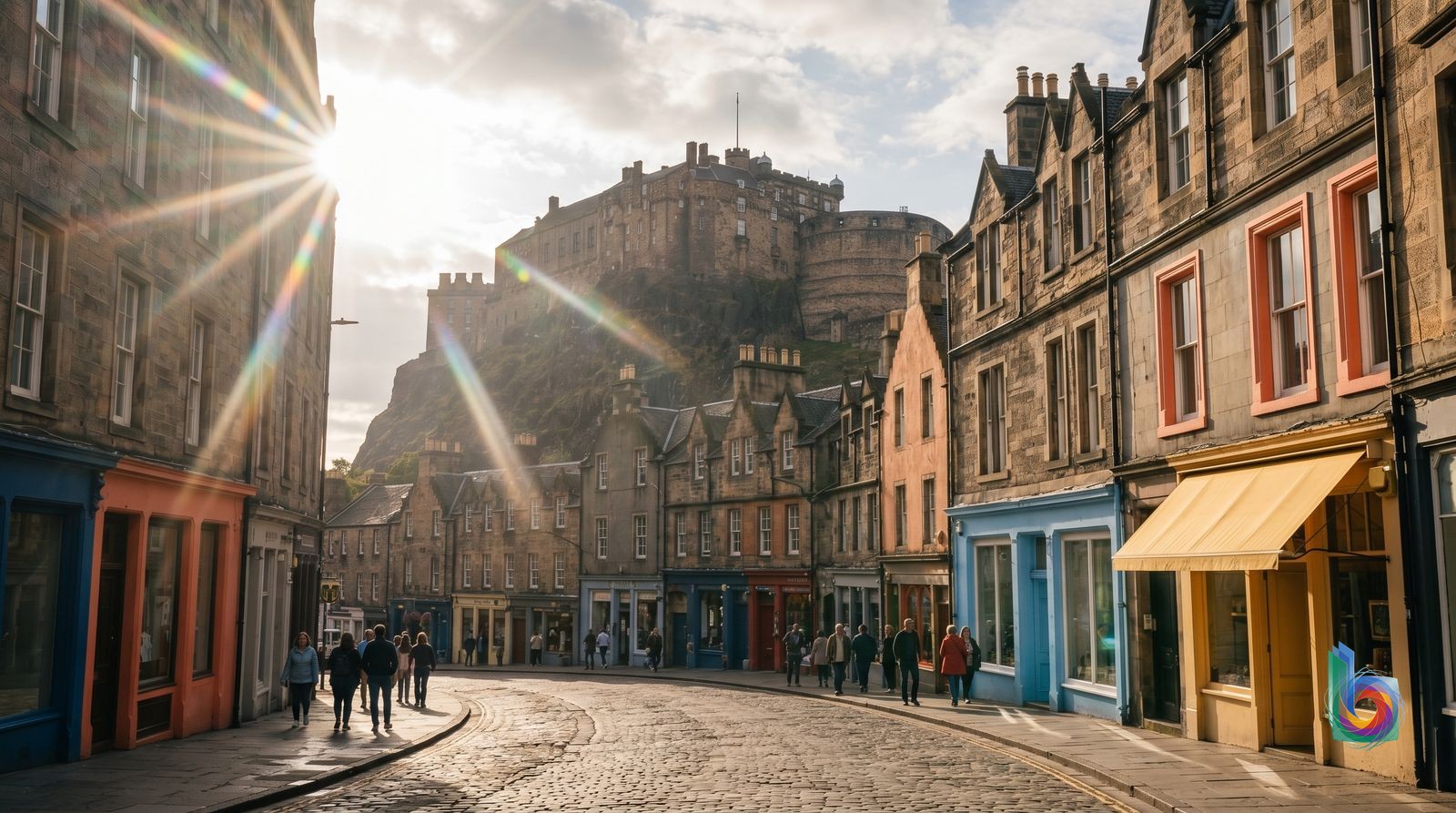
Season by season
December–February
Atmospheric but properly wintry: short daylight, routine wind and rain, and occasional icy wet cobbles. Outside the festive peak, it is often the best-value time for rooms and the city feels more lived-in than performative.
Hogmanay reverses the value equation: accommodation and central reservations become expensive and scarce. Some seasonal attractions and tours run reduced schedules, and daylight is limited.
March–April
A shoulder season with lengthening days and a city beginning to wake up, but Edinburgh weather remains changeable rather than reliably springlike. Waterproof layers still matter.
It can feel cold, wet and windy, and school-holiday periods can still put pressure on castle and family-attraction tickets.
May–June
The best overall compromise: noticeably longer days, generally milder conditions and a city that still works for residents as well as visitors. Expect rain at any point; Edinburgh is not a warm-weather guarantee.
This is popular, so book well-located accommodation and peak-date timed entries ahead. Prices rise as summer approaches.
July
Long days and lively summer energy, with increasing visitor numbers and school-holiday pressure. It is a useful choice for those wanting summer daylight without August’s full festival crush.
Accommodation is pricier and major sights can be busy; late July begins to feel like the run-up to festival season. Do not expect reliably dry or hot weather.
August
Edinburgh at maximum intensity. The Festival Fringe, Edinburgh International Festival and Royal Edinburgh Military Tattoo make the centre extraordinarily lively; the Old Town in particular is crowded and slow to navigate.
This is the least relaxed and usually most expensive month. Rooms, restaurants and headline performances need advance booking, and getting across the Royal Mile or between venues takes longer. Book accommodation at least six months ahead; Tattoo tickets should be bought as soon as dates go on sale.
September
One of the strongest months to visit: conditions can still be mild, days remain usable, and the festival pressure has eased. The city regains some breathing room after August.
Weather becomes more autumnal as the month progresses, and popular sights can remain busy in early September.
Events worth planning around
Edinburgh Festival Fringe · Usually most of August, with dates varying slightly each year.
The world’s largest arts festival transforms central Edinburgh: accommodation prices jump, the Old Town and venue districts become crowded, and headline or one-off performances should be booked once your programme is set. Do not assume door tickets will be available.
Edinburgh International Festival · Usually August, overlapping with the Fringe.
Adds high-demand opera, theatre, music and dance to an already packed city. Book priority performances early and expect festival-period hotel and restaurant pressure.
The Royal Edinburgh Military Tattoo · Usually August, on the Castle Esplanade.
A genuine sell-out that also adds evening congestion around Edinburgh Castle and the Royal Mile. Buy tickets as soon as dates go on sale if it is a trip priority.
Edinburgh’s Christmas and Hogmanay · Christmas programming usually runs from late November into early January; Hogmanay centres on late December and New Year’s Day.
Festive markets and New Year celebrations make the centre much busier. Hogmanay in particular pushes up room rates and makes central accommodation, restaurants and transport plans much harder to secure; winter is cheaper only outside this peak.
Getting around
Walking
The Old Town/Royal Mile, Grassmarket, New Town, Princes Street and the main central sights. It is the best way to experience Edinburgh, not merely get between attractions.
Group the day geographically and keep it modest: two substantial sights plus wandering is realistic. Wear shoes with grip for wet cobbles, and use Waverley as a useful central reference point.
Central does not mean level. Old Town, Grassmarket, Holyrood/Canongate, Calton Hill and the route between New Town and Old Town all involve serious slopes, stairs or cobbles; Stockbridge is an uphill return from the centre. The railway cutting and bridges create awkward gaps, so map routes can look easier than they feel.
Lothian Buses
Leith, Stockbridge and Inverleith/Botanic Garden, Southside, Bruntsfield and Morningside, Holyrood, Portobello, the zoo and Craigmillar—anywhere beyond the compact core or off the tram line.
Use the frequent burgundy-and-cream Lothian Buses. Tap the same contactless card for each ride; daily spending on that card is capped at the day-ticket price. Cash requires exact change and offers no benefit.
Buses are the answer to Edinburgh’s network gaps, but traffic and festival crowds can slow them. There is no tram through Stockbridge, Southside, Bruntsfield/Morningside or Portobello, and Grassmarket itself is less convenient for boarding than the nearby bridges and main streets.
Tram
Airport arrivals; Haymarket, Princes Street, St Andrew Square and Leith/Newhaven. It is particularly handy if you are staying in New Town, the West End/Haymarket or Leith.
Treat it as one useful corridor, not a metro system. Check whether a stop is genuinely close to your hotel before choosing it over the Airlink from the airport; the airport is in a separate fare zone.
The line does not penetrate Old Town, Grassmarket, Stockbridge, Southside, Bruntsfield/Morningside, Holyrood or Portobello. From Princes Street, Old Town still means an uphill walk; from Leith, it is not a substitute for being close to the Castle and Royal Mile.
Taxi
Late nights, luggage-heavy arrivals, reduced-mobility needs, and journeys when a steep Old Town or Calton Hill climb would spoil the day. It is also sensible after major shows, sport or pub closing time.
Book ahead when demand will be obvious—after football or rugby at Murrayfield, major performances, and late-night weekends. Waverley is central, but its exits and the climb into Old Town can make a short taxi worthwhile with bags.
Do not leave booking until the last minute after events or at closing time: availability tightens and drunken crowds can make pickup unpleasant. Taxis are a fallback, not the efficient default for daytime central sightseeing.
Car (avoid for a city stay)
Only for trips beyond Edinburgh where the car is the point—such as a wider Scotland itinerary—not for moving around the city itself.
If you arrive by car, park it and use walking, buses and the tram for the centre.
Parking is expensive, streets are constrained, and the Old Town’s slopes, one-way patterns and pedestrian-heavy areas make driving more trouble than value. It is especially unhelpful in Old Town, Grassmarket, New Town and Leith.
Safety: Edinburgh is generally safe, but keep valuables close in crowded areas around the Royal Mile and Waverley, and pre-book a taxi or leave early after major events rather than getting caught in late-night drunken crowds.
Book before you land
Edinburgh Castle — reserve a timed entry before arrival in peak season and school holidays; summer dates regularly sell out. Aim for 4–6 weeks ahead for July/August, earlier if your dates are fixed. · The Royal Edinburgh Military Tattoo — if you are visiting in August, book as soon as dates go on sale. This is a genuine sell-out, not a walk-up event. · The Real Mary King’s Close — timed tours have limited capacity and can sell out, especially weekends, school holidays and August; book several days ahead, or weeks ahead in festival season. · Palace of Holyroodhouse — book ahead for a fixed date in peak season, particularly if it is central to your itinerary; check its calendar because it remains a working royal residence and can close. · Popular Edinburgh Festival Fringe and International Festival performances — do not assume you can buy on the door in August; book headline shows and any one-performance-only event once your programme is set.
- Use contactless card payment. It is widely accepted on buses, trams, pubs and shops; on buses, cash requires exact change and gets you no advantage.
- The Old Town is not flat despite the map. Build slack into routes, wear shoes with grip, and do not drag a wheeled suitcase up the Royal Mile if your accommodation is down a steep close.
- Keep valuables close in crowds around the Royal Mile, Waverley and festival venues. Edinburgh is generally safe, but pickpocketing is a real nuisance in packed tourist areas.
- Avoid the last-minute taxi scramble after football, rugby, major shows and pub closing time. If you need a cab, book or leave slightly early; avoid getting drawn into drunken crowds.
- Do not confuse airport fares with ordinary city fares: the airport is a separate tram fare zone. A normal city tram/bus day ticket does not cover travel to or from EDI.
- For a quieter evening, move beyond the Royal Mile. Its central pubs are convenient but can be crowded and generic; Stockbridge, Leith and the Southside feel more like neighbourhoods than a visitor funnel.
Worth leaving the city for
StirlingFull day — allow 7–8 hours door to door; direct trains from Waverley take roughly 50 minutes each way, plus the uphill walk to the castle.
The best historical counterpoint to Edinburgh: another crag-top castle, but a smaller, more legible old town and the Bannockburn story give it a different charge. Go if you want one serious castle day without pretending a rushed Highlands coach tour is a good use of time.
North Berwick and Tantallon CastleFull day — roughly 8–9 hours door to door. The train from Waverley to North Berwick is about 35 minutes; add local transport or a taxi for Tantallon.
This is the escape when Edinburgh’s closes, queues and uphill pavements have worn thin: a real East Lothian seaside town, the extraordinary Bass Rock offshore, and the wind-battered ruins of Tantallon Castle. It delivers coast, birds and space that the city cannot.
St AndrewsFull day — allow 9–10 hours door to door. The practical public-transport route is train to Leuchars, then a bus or taxi into St Andrews.
Worth it for the collision of ancient university streets, cathedral-and-castle ruins and the birthplace mythology of golf. It is more beautiful and more coherent than a quick Glasgow dash, but only if you are interested in its academic, coastal or golfing identity; otherwise Edinburgh still has the deeper first-timer sights.
South QueensferryHalf day — about 4–5 hours door to door. Train to Dalmeny is quick from central Edinburgh, followed by a walk down into South Queensferry.
A short, low-effort change of scene: an old harbour town under the three Forth crossings, especially the red cantilever Forth Bridge. Choose it for a half-day breather and industrial-scale scenery, not for a packed list of attractions.
Falkirk WheelMost of a day — allow 6–8 hours door to door, because the final connection from Falkirk’s rail stations to the Wheel adds time.
The Falkirk Wheel is an actual piece of improbable modern engineering, not another generic Scottish high street: it lifts canal boats between two waterways. Pair it with the Kelpies only if your interest is design and infrastructure; culture-first visitors should stay in Edinburgh or go to Stirling instead.