- Pace
- For a first visit of seven to ten nights, choose Athens plus one island pair in the same ferry chain, or Athens plus a mainland road trip. With two weeks, combine Athens with Crete, the Peloponnese or northern Greece—not all three. Athens–Thessaloniki is the main north–south rail axis, but much of the best mainland travel needs a car, while even logical Cycladic ferry transfers can consume half a day.
- When to go
- For the best first trip, go in May–mid-June or, better still, September: you get workable ferry schedules, pleasant site-going weather and far less pressure than high summer. July and August are for committed beach travelers who accept heat, wind, crowds and inflated island prices; use them for one island area rather than a grand circuit. Spring and early autumn favor the mainland, Crete and Rhodes, while November–February works for Athens, Thessaloniki and a mainland road trip—not frictionless island-hopping.
- Daily budget
- €180–320
Greece is not one trip but a compact, logistically fragmented Mediterranean country where ancient sites, a lived-in capital, mountain villages, road-trip coasts and island life all run on different rhythms. Beyond Athens and the postcard islands, its strength is range: Byzantine and Ottoman layers in the north, dramatic mainland driving in the Peloponnese and Epirus, Venetian port towns, and regional food that changes sharply from place to place. The catch is that its geography punishes indiscriminate itinerary-building: ferries are real transport days, not sightseeing cruises, and the islands do not form one easy circuit.
Known for
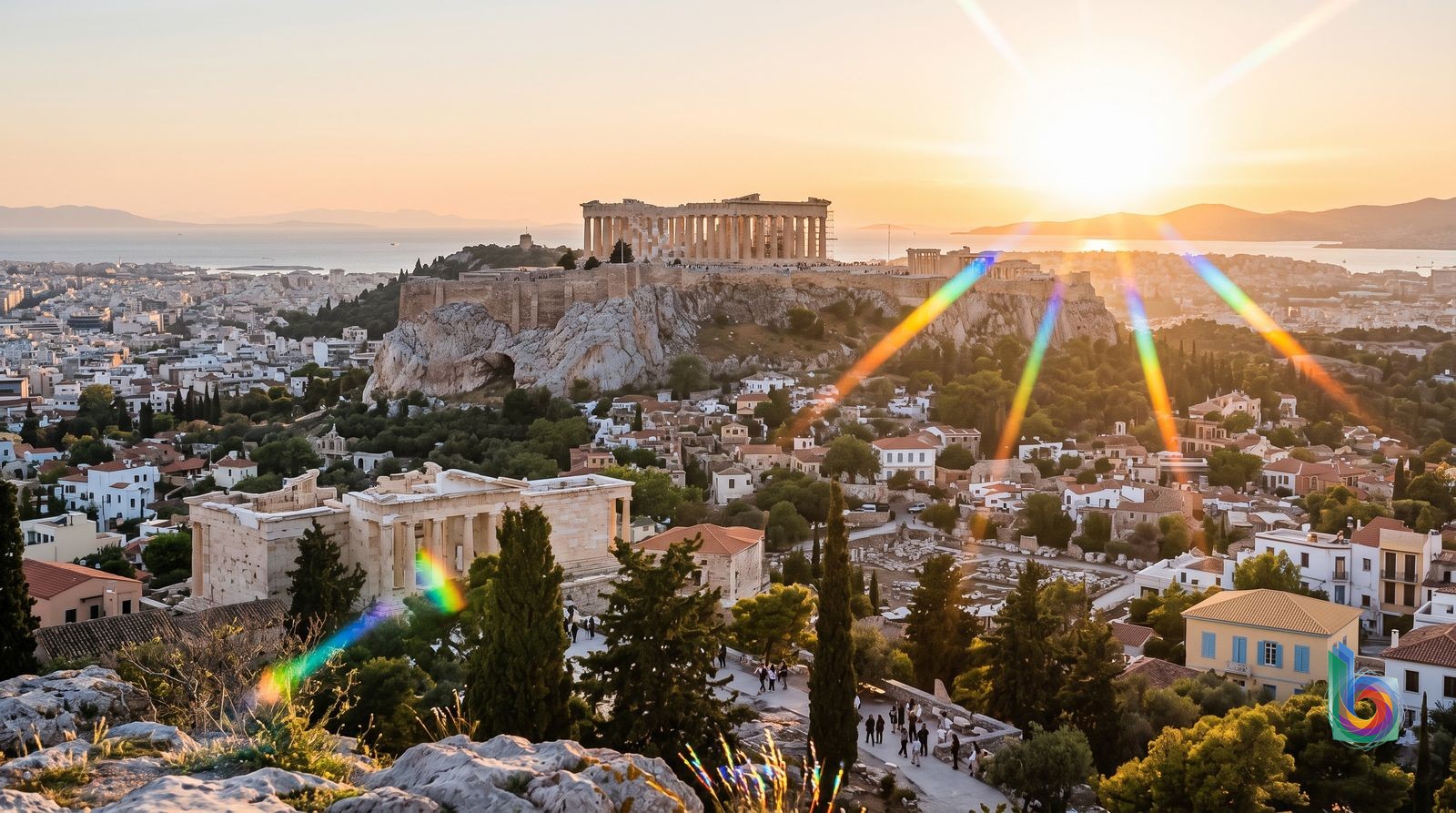
- Athens, the Acropolis and Greece’s classical archaeological sites
- The whitewashed, wind-scoured Cyclades, especially Santorini and Mykonos
- A vast island network, from Crete and the Ionian islands to Rhodes and the Dodecanese
- Mainland road-trip country: the Peloponnese, Meteora, Epirus and mountain villages
- Venetian, Byzantine and Ottoman history beyond the classical layer
- Regional cooking, olive oil, seafood, pies, cheeses and distinctive local wines
Where to go
Base · 1–3 nights
Athens and Attica
Start here for the Acropolis, serious museums, dense neighborhood life and Greece’s strongest urban food scene. It is noisy and hot rather than picturesque, so give it three nights instead of treating it as an airport stop.
The Cyclades
Base · 6 nights
The whitewashed, dry Aegean islands are best done as one headline stop—Santorini for the caldera—paired with somewhere more lived-in such as Naxos, Paros, Milos, Syros or Tinos. Ferries are scenic but consume time; do not mistake a transfer day for a beach day.
The Peloponnese
Base · 7 nights
This is Greece’s best mainland road trip: Nafplio, Mycenae, Epidaurus, Nemea, Mani, Monemvasia, Messinia and Olympia all belong in the same big, varied peninsula. A car is essential if you want more than a narrow strip of highlights.
 4
Crete
Base · 8–10 nights
Crete has enough substance for a trip of its own: Venetian Chania and Rethymno, Minoan sites around Heraklion, mountain villages, hikes, coves and Greece’s most distinctive regional cooking. Pick west or central/east for a short trip; the island is far bigger than maps make it look.
Delphi, Meteora and Thessaly
Base · 2 nights
Delphi’s mountainside sanctuary and Meteora’s monasteries on sandstone towers make the strongest culture-and-landscape pairing on the mainland. It deserves overnight stops, not a punishing Athens day trip, especially when rail works or road transfers complicate the route.
Thessaloniki and Greek Macedonia
Base · 3–5 nights
Greece’s northern counterweight to Athens is looser, more Balkan and Ottoman in character, with excellent casual eating, Byzantine monuments and a waterfront city rhythm. Use it as a base for Vergina, Naoussa wine country, Mount Olympus or a separate beach extension to Halkidiki.
 7
Epirus
Base · 3–4 nights
Come for Ioannina, Zagori’s stone villages and bridges, Vikos Gorge, rafting country and the Ionian-facing coast near Parga. The winding roads and cooler, wetter mountain weather make this a deliberate driving trip, not an efficient tick-box circuit.
The Ionian Islands
Corfu, Kefalonia, Zakynthos and Lefkada are greener, softer and more Italianate than the stark Cyclades, with coves, family beaches and sailing water. Treat them as a western-Greece trip via regional airports and road-ferry links, not as an add-on to Santorini.
 9
Rhodes and the Dodecanese
Rhodes combines one of Greece’s best-preserved medieval old towns with Lindos and proper beach time; Kos and smaller islands add easier second-trip options. This far southeastern chain is usually worth flying to rather than sacrificing a day to a long ferry from Athens.
Don't miss
This is the essential Athenian hilltop experience, where the city’s signature ancient monuments read as one carefully choreographed landscape. Take the earliest entry slot, then descend toward the museum rather than trying to see it at midday.
The monasteries and their rock setting make this one of Greece’s most singular landscapes, not simply a collection of religious sites. Base in Kalambaka or Kastraki, choose a few monasteries rather than rushing through all of them, and allow time for the road viewpoints.
This is the best corrective to seeing the Acropolis as a bare ruin: it reconnects the hill’s fragments, sculpture and daily context. Visit after the Acropolis, when the site you have just walked makes the galleries far more legible.
Athens is not only a gateway: its ancient core, museums, food streets and layered modern neighborhoods reward several nights. Use it as a walkable base for the major classical sites, with Plaka and the Acropolis area handled early in the trip.
Knossos is the indispensable entry point to Minoan Crete, but it is best understood alongside the exceptional objects in Heraklion’s museum. Go with a guide or good audio guide, as interpretation and reconstruction are central to the experience.
Santorini earns its place for the caldera landscape and cliffside settlements, not because every village needs to be treated as a checklist stop. Stay on the caldera, walk a section of the rim, and plan your most popular sunset viewpoint outside peak evening hours.
Getting your bearings
Pins are the top attractions, ranked by the corner badge — click one for details.
The mental map
Think in four broad travel zones: Athens and central mainland; the Peloponnese and western mainland; northern Greece; and the island groups. Within the islands, treat the Cyclades, Crete, Ionian, Dodecanese, Sporades and North Aegean as separate regions rather than interchangeable stops: the Ionian is greener and western-facing, Crete is country-sized, and Rhodes is far southeast enough that flying often beats a long ferry from Athens.
When to go
For the best first trip, go in May–mid-June or, better still, September: you get workable ferry schedules, pleasant site-going weather and far less pressure than high summer. July and August are for committed beach travelers who accept heat, wind, crowds and inflated island prices; use them for one island area rather than a grand circuit. Spring and early autumn favor the mainland, Crete and Rhodes, while November–February works for Athens, Thessaloniki and a mainland road trip—not frictionless island-hopping.
Pacing a visit
For a first visit of seven to ten nights, choose Athens plus one island pair in the same ferry chain, or Athens plus a mainland road trip. With two weeks, combine Athens with Crete, the Peloponnese or northern Greece—not all three. Athens–Thessaloniki is the main north–south rail axis, but much of the best mainland travel needs a car, while even logical Cycladic ferry transfers can consume half a day.
Book before you land
Getting in
ATHAthens International Airport
The main international gateway and the right default for first trips: it serves Athens, connects to Piraeus for Cycladic ferries, and has frequent domestic flights to Crete, Rhodes, Corfu and other islands. Do not plan a tight same-day flight-to-ferry connection.
SKGThessaloniki Airport
The useful gateway for northern Greece, including Thessaloniki, Halkidiki, Macedonia and onward Balkan travel. It is far more sensible than backtracking through Athens for a northern itinerary.
HERHeraklion International Airport
Crete's principal airport and the best arrival or departure point for central and eastern Crete, Knossos and Heraklion. Open-jaw itineraries using Heraklion and Chania avoid wasteful island backtracking.
CHQChania International Airport
The gateway for western Crete: Chania, Rethymno, the White Mountains and west-coast beaches. Use it with Heraklion for a proper Crete trip rather than treating the island as a short ferry add-on.
RHORhodes International Airport
The practical entry point for Rhodes and the southeastern Dodecanese. Fly here when time matters; the ferry from Piraeus is long enough to consume much of a holiday day.
Before you go
Questions worth settling
How many days do I need for a first trip to Greece?
Allow 7–10 nights for Athens plus either a pair of islands in the same ferry chain or a mainland road trip. With two weeks, add Crete, the Peloponnese or northern Greece—but do not try to combine all of them.
Where should I base myself on a first visit?
Give Athens three nights for the Acropolis, museums, neighborhoods and food, rather than using it only as an airport stop. Then choose one focused second base: the Cyclades, the Peloponnese, Crete, or Rhodes and the Dodecanese.
Which Greek destinations combine well—and which should I avoid combining?
Pair Athens with Santorini and Naxos, Paros, Milos, Syros or Tinos within the Cyclades, or combine Athens with a Peloponnese driving route through Nafplio, Mycenae, Epidaurus and beyond. Treat the Ionian Islands as a western-Greece trip, and fly to Rhodes rather than trying to add it to a Santorini itinerary by long ferry.
Do I need a visa for Greece?
Greece is in the Schengen Area: EU/EEA/Swiss visitors may enter with valid ID or a passport, while US, Canadian, UK, Australian and many other visa-exempt travelers can normally stay up to 90 days in any 180-day Schengen period. Other nationalities need a Schengen visa; check current passport rules and ETIAS rollout status before booking.
Should I rent a car or use ferries and trains?
Use ferries only within one island group, and count every crossing as a transfer day; winds can disrupt Cycladic services. Rent a car for the Peloponnese, Crete, Epirus and most northern routes, while Athens–Thessaloniki is the main rail link and distant islands such as Crete, Rhodes and Corfu are usually best reached by domestic flight.
What is the best time to visit Greece?
May to mid-June and especially September offer the best balance of ferry schedules, comfortable weather and lower pressure than peak summer. July and August suit beach-focused trips if you accept heat, crowds, wind and high island prices; spring and early autumn are particularly good for the mainland, Crete and Rhodes.
What should I book ahead?
Reserve Acropolis timed entry and, in peak season, the Acropolis Museum; book major summer high-speed Cycladic ferries early as well. In June–September, prebook Santorini caldera cruises, and arrange Samaria Gorge hikes or transfers ahead in peak summer; in July and August, reserve accommodation and rental cars well in advance.
Known for
- Athens, the Acropolis and Greece’s classical archaeological sites
- The whitewashed, wind-scoured Cyclades, especially Santorini and Mykonos
- A vast island network, from Crete and the Ionian islands to Rhodes and the Dodecanese
- Mainland road-trip country: the Peloponnese, Meteora, Epirus and mountain villages
- Venetian, Byzantine and Ottoman history beyond the classical layer
- Regional cooking, olive oil, seafood, pies, cheeses and distinctive local wines


